In the last week the Church of England has published four substantial papers intended to provide theological, legal, and doctrinal clarity on matters arising from the Living in Love and Faith (LLF) process.
They cover everything from the nature of doctrine itself (GS Misc 1429), to the doctrine of marriage and the Prayers of Love and Faith (GS Misc 1430), to the question of clergy exemplarity (GS Misc 1431), and the legal mechanisms for authorising services (GS Misc 1432).
Taken together, they represent the latest attempt by the Church’s theological establishment to reconcile pastoral compassion with institutional caution. Sadly, they fall short — not because they lack scholarship, but because they lack imagination and courage. They defend the letter of inherited formulations while neglecting the living Spirit that animates them.
A living God, but a dead Doctrine
The first paper, The Nature of Doctrine and the Living God, begins promisingly. It speaks of doctrine as “true knowledge about God” — knowledge that is living and dynamic, communally discerned and responsive to Scripture. So far, so good. Yet the authors then draw back, rejecting the notion of “development of doctrine” as “unhelpful.”
That is a fatal contradiction. If doctrine reflects the living God, it cannot be static. The Church’s understanding of God has always evolved: through the abolition of slavery, the ordination of women, and the recognition of remarriage after divorce. To suggest that doctrine cannot grow is to suggest that revelation is complete — a claim the Church, other than at its most extreme fringes, has never made.
Christian truth is not preserved by freezing it in the past but by allowing the Spirit to breathe new life into old words. The Anglican tradition’s genius has always been its ability to hold Scripture, reason, and tradition in creative tension. The newly published papers from the Faith and Order Commission (FAOC), by contrast, mistake that tension for paralysis.
Symbolism, suspicion, and the fear of blessing
The second paper, The Doctrine of Marriage and the Prayers of Love and Faith, argues that public use of these prayers for same-sex couples might “appear to endorse” relationships the Church does not (yet) recognise as marriage. Its anxiety centres on symbolism — that rings, gestures, and vesture could imply too much blessing.
It is, at heart, a theology of fear.
Fear that the Church might be seen to love too widely.
Fear that prayer might look too much like celebration.
Fear that God’s grace might show up where the hierarchy has not authorised it.
Yet the Christian Gospel is nothing if not public. Jesus’s blessings were never whispered privately in back rooms; they were shouted across fields and feasts and funerals. The healing touch, the shared meal, the welcome to the outcast — all were acts of public worship before any liturgical text was drafted.
If the Church believes that prayer changes lives, then praying with and for same-sex couples should be a source of joy, not scandal. A faith afraid of its own prayers has ceased to trust the Spirit who inspires them.
Exemplarity and the double standard
The third document, on clergy discipline and “exemplarity,” is perhaps the most troubling. It argues that clergy in same-sex civil marriages raise questions about the coherence between doctrine and discipline. Clergy, it suggests, must model “wholesome examples and patterns of life” as set out in the ordination service.
No one could disagree with that. But the paper then assumes — without argument — that same-sex marriage is incompatible with such exemplarity. It is a circular logic: same-sex relationships are unwholesome because the Church says so, and the Church says so because they are deemed unwholesome.
This is not theology; it is tautology.
If exemplarity means living with integrity, faithfulness, and self-giving love, then clergy in committed same-sex marriages are models of precisely that. To exclude them is to exalt conformity over character and compliance over conscience.
Law as a cage, not a framework
The final paper, the Legal Advice, offers a detailed account of the canonical processes for authorising liturgy. It warns clergy that using “commended” but unauthorised prayers could expose themselves to ecclesiastical discipline. The tone is cautious, procedural, and defensive — as though the first task of law were to restrain grace rather than to order it.
Canon law is meant to serve the Gospel, not to imprison it. The Church has changed its laws countless times when conscience demanded it — on remarriage, on women’s ministry, on liturgical reform. The same courage is now needed to recognise that blessing same-sex couples is not an act of rebellion but an act of obedience to Christ’s command to love one another as he loves us.
The theological heart of the matter
What all four papers share is a tragic inversion of priorities. They begin with fear of contradiction rather than hope of revelation. They ask how to contain love rather than how to celebrate it. They treat LGBTQ+ inclusion as a threat to orthodoxy, rather than a test of the Church’s faith in the wideness of God’s mercy.
But Scripture gives us a different pattern. Peter’s vision in Acts 10 shattered the early Church’s assumptions about purity and belonging. “What God has made clean, you must not call profane.” The same Spirit who broke the barrier between Jew and Gentile now breaks the barrier between straight and queer. The same love that sanctifies every covenant of fidelity sanctifies ours too.
The true question is not whether blessing same-sex couples changes doctrine, but whether refusing to bless them betrays the Gospel.
Towards a Church of courage and compassion
The Church of England stands at a crossroads. One path clings to caution, mistaking delay for discernment. The other steps forward in faith, trusting that God’s love is wider than our fear. FAOC’s reports, though erudite, counsel the former. But history — and the Spirit — will demand the latter.
If doctrine is truly the Church’s living knowledge of the living God, then it must change as we encounter new manifestations of grace.
If marriage is truly a sign of God’s faithful covenant, then it cannot be denied to those whose love bears that same faithfulness.
And if the Church is truly the Body of Christ, then every baptised person — queer or straight, trans or cis — must be embraced as a full and equal member of it.
Anything less is not orthodoxy. It is exclusion dressed as theology.
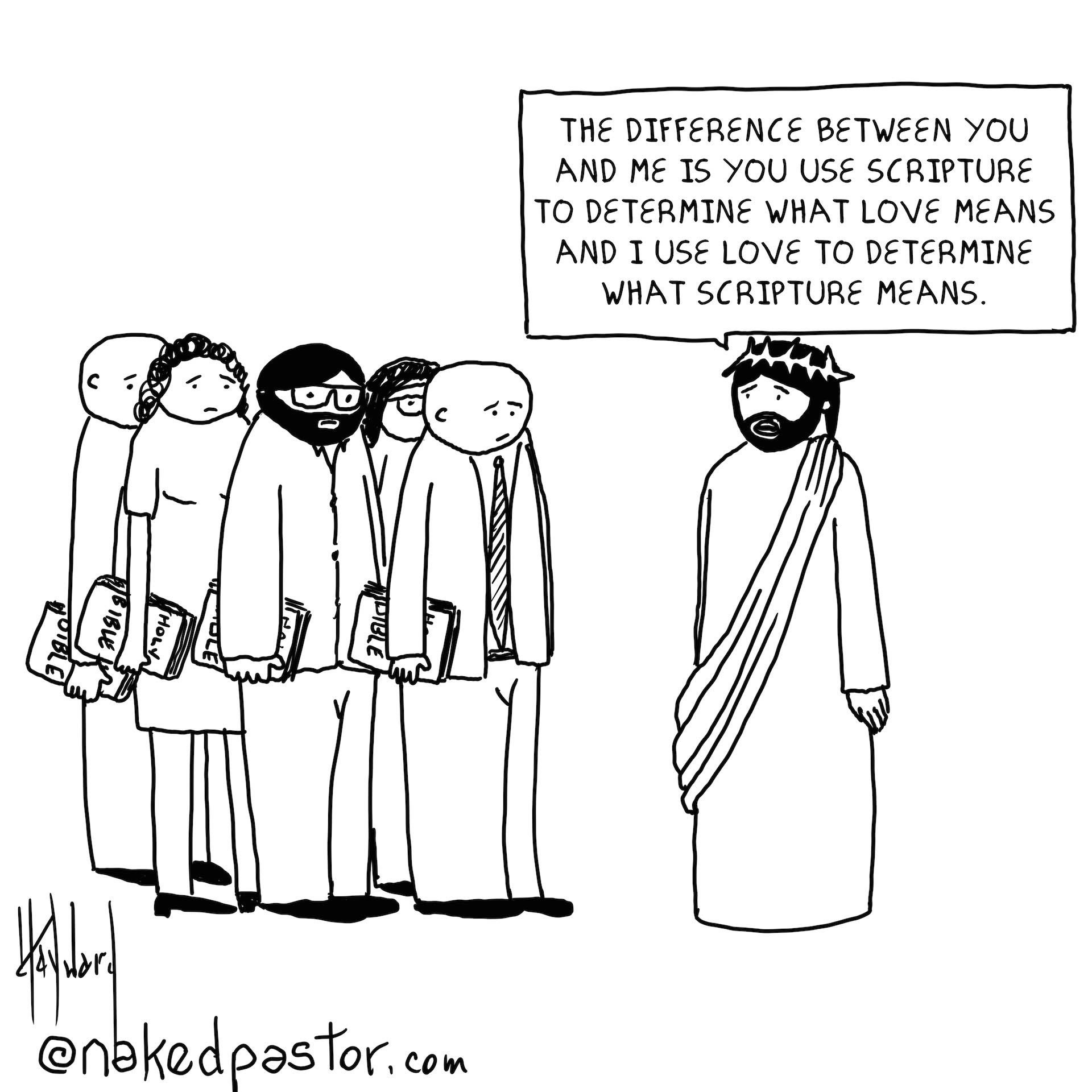
With grateful thanks to The Naked Pastor for his insightful cartoon.


 C. E. Lord OBE