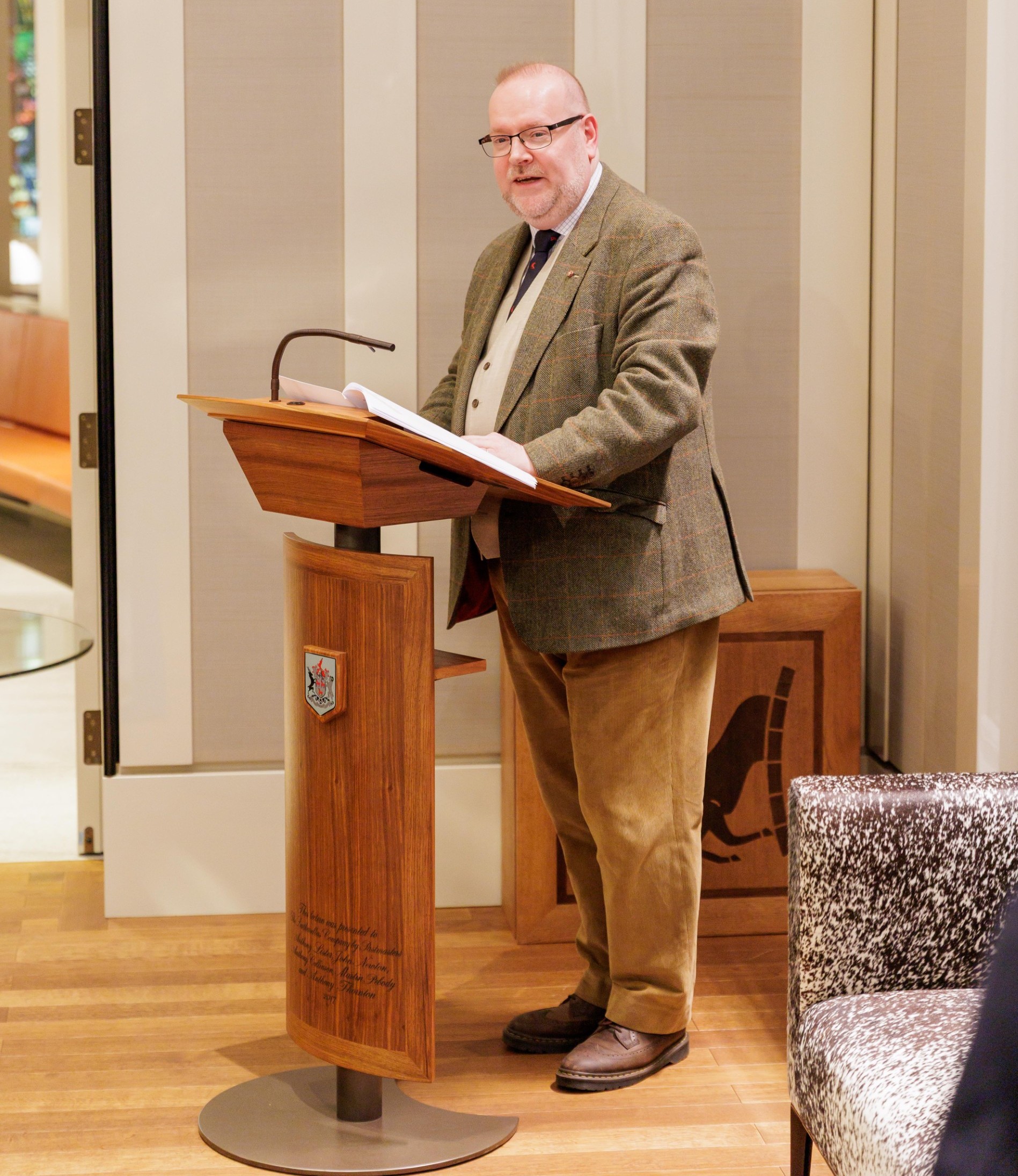
Twenty‑five years ago, at the age of 29, I walked into Guildhall as a newly elected Common Councillor with far more opinions than experience and a touching faith that if one simply memorised the Standing Orders, everything would turn out all right. I still believe that last bit, although experience has taught me that rules are only ever as good as the culture that surrounds them.
This week marks a quarter of a century since that first election. It has prompted a flood of memories, not all of them comfortable, but overwhelmingly shaped by affection for this place, this institution, and the people who give it life. The speech I gave at Leathersellers’ Hall earlier this week captured something of that tone: gratitude, humour, and a deep belief that institutions can change, even those as ancient and peculiar as the City of London Corporation.
A very different City
The Corporation I joined in 2001 would be scarcely recognisable to many Members today. My fellow Councilmen were older, more monochrome, and more certain of their ways. We still used fax machines. Emails were printed out before being read. Diversity was understood in geographical rather than human terms. Dark suits and sombre ties were not just customary but culturally enforced. Members had to bring guests of the opposite sex to civic functions.
More importantly, there were entire conversations that simply did not happen. Sexuality, mental health, neurodiversity, faith as lived rather than performed, and the experience of people who did not fit the prevailing mould were largely absent from public discussion. Not forbidden, exactly, but unsayable. Silence functioned as a kind of discipline.
And yet, even then, the City was not the caricature sometimes painted by its critics. Beneath the formality was a genuine civic instinct, a seriousness about stewardship, and a belief that the Square Mile existed not only for itself but for London and the nation. An institution that didn’t just clean the City’s streets, but that also provides the Central Criminal Court (Old Bailey), the Barbican arts centre, the Guildhall School of Music & Drama, London’s biggest grant-maker, schools and academies, housing across half a dozen London boroughs, and serving as custodian of over 11,000 acres of public open space including Hampstead Heath and Epping Forest. It was that sense of duty and breadth of responsibility that kept me here for so long.
Learning the City’s grammar
My early years were an education in the City’s ritual grammar. The rhythm of elections, committees, and Common Council; the choreography of Common Hall and the Silent Ceremony; the quiet authority of officers who carry institutional memory in their heads and the Corporation on their shoulders. I learned that ceremony is not mere decoration. Done well, it encodes values: continuity, service, and respect for office rather than office‑holders.
I also learned that governance is not about control but about trust. The most effective chairs I observed were those who created space for disagreement and honest debate without letting meetings dissolve into theatre. The best decisions were often the least dramatic, arrived at through patient questioning and an insistence on clarity. The worst were often those railroaded through by leaders who had their own agendas.
Over the years I have served on more committees than is probably healthy and chaired quite a few: Licensing, Standards, Establishment, Gresham, Civic Affairs, the Girls’ School, Sport. I have seen good decisions and bad ones, moments of generosity and moments when fear or habit got the upper hand. I have learned, sometimes the hard way, that culture eats structure for breakfast.
Change, slow and sometimes sideways
The City has changed over these 25 years. Not in a straight line and not always by design. Sometimes change came because the world outside shifted and the Corporation had to respond. Sometimes it came because individuals pushed, patiently or otherwise, against assumptions that no longer served.
Our elected membership is younger now, more diverse, and more willing to talk about who we are and how we live. There is still work to do, but the idea that you can be openly queer, openly neurodivergent, openly struggling, or openly different and still belong here is no longer controversial in the way it once was.
Inclusion, I have learned, is not about erasing tradition but about deciding who tradition is for. Institutions survive when they reflect the society they serve, not when they freeze themselves at a moment of past comfort. The City can be ceremonial and humane, traditional and progressive, serious and kind. At its best, it already is.
Beyond money
One of the persistent misunderstandings about the City of London is that it is only about money. Finance matters, of course, and the Square Mile’s economic role is nationally and internationally significant. But it is not the whole story.
Over the years I have been drawn repeatedly to the City Corporation’s work in culture, sport, education, and open spaces. These are not distractions from the core business of promoting financial and professional services and keeping the City clean and in good order; they are expressions of it. They are how the City earns its place in the wider civic landscape. From schools and charities to sport and the arts, from ancient livery companies to modern partnerships, the Corporation’s soft power is one of its greatest strengths.
I have also come to believe fiercely that good governance is itself a public good. Whether in the City, in universities, in charities, or in sport, the same principles apply: clarity of purpose, accountability, and the courage to ask awkward questions at the right moment.
People, always people
If there is one lesson that stands above all others, it is that you do not do any of this alone. The City’s greatest asset is not its buildings or its balance sheet but its people: Members and officers, partners and volunteers, critics and friends.
I owe an enormous debt to colleagues who have argued with me and agreed with me, voted for me and against me, backed me and, on occasion, sacked me, and still turned up for a drink afterwards. That capacity to disagree fiercely and then share a table is one of the City’s quiet virtues.
I am particularly grateful to officers past and present, whose professionalism and patience make the institution function. They are the keepers of continuity and the enablers of change, often at the same time.
On a more personal note, I have lived far more openly and honestly over these 25 years than I ever imagined I could when I first walked into Guildhall. That has only been possible because many people chose my inclusion over their comfort, created space, and showed kindness when it would have been easier not to.
Sacred keys
There is a phrase I learned long before I came to the City: sacred keys open doors. It has followed me through my life and my public service. Over the last quarter of a century, I have been lucky enough to hold a few keys and, occasionally, to prise open a few doors. Sometimes quietly. Sometimes with a crowbar.
The work is never finished. Institutions drift if they are not tended. Cultures calcify if they are not questioned. But my experience of the City of London Corporation is that it can change, and that when it does, it does so with a seriousness that matches its age.
Looking ahead
Anniversaries are moments for reflection, but they are also moments to look forward. The next chapter for the City will bring new challenges and new opportunities: economic uncertainty, technological change, questions of trust in institutions, and the continuing imperative to be inclusive, outward‑looking, and humane.
As for me, I remain grateful beyond measure for the friendships, the arguments, the laughter, and the privilege of service. Twenty‑five years have passed far more quickly than any of us would like to admit. I hope the next chapter, whatever it holds, will be guided by the same belief that has sustained me so far: that institutions can change, that governance can be kind, and that the City of London, at its best, is an extraordinary force for good.
Here’s to the City, to those who serve it, and to the doors still waiting to be opened.
Photo credit: Richard Krakowski
Richard’s images from the reception at Leathersellers’ Hall and service at St Lawrence Jewry can be found here.


 C. E. Lord OBE