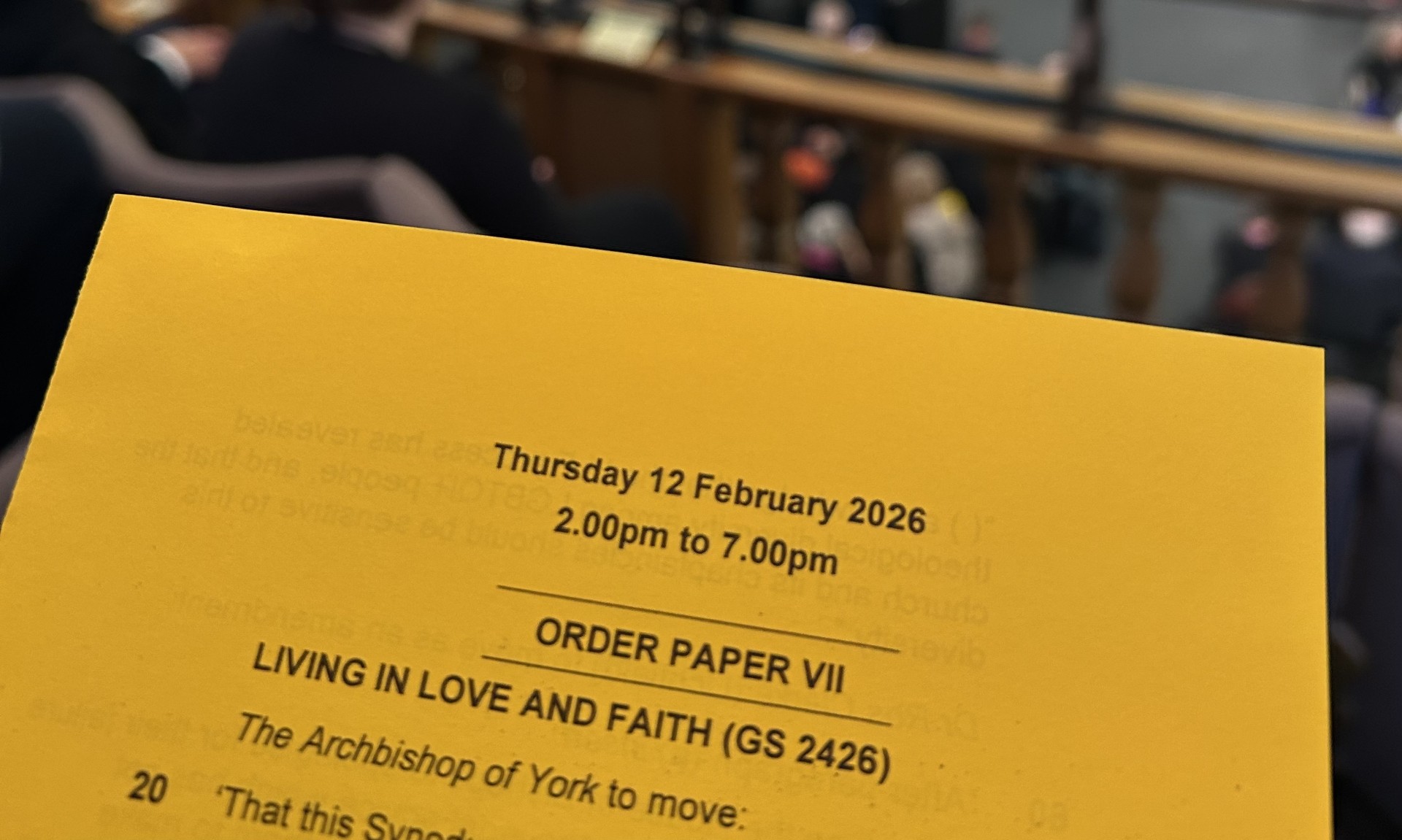
Yesterday I sat in the public gallery at Church House and watched the Church of England step back from the modest, careful and prayerful work of Living in Love and Faith, which was meant to move towards providing a loving Christian welcome for LGBTQ+ people in England’s established Anglican faith.
I left feeling numb. Not surprised. But deeply, profoundly saddened.
For many of us, LLF was never perfect. It was slow and it asked LGBTQ+ people to be patient yet again while our lives were treated as a theological problem to be managed. But it was at least a process that acknowledged our existence, affirmed that we are loved by God and held out the possibility that the Church might one day recognise that love in its common life.
Now even that limited hope has been withdrawn.
The General Synod motion passed yesterday formally concludes the Living in Love and Faith programme and replaces it with a new working group on relationships, sexuality and gender. There is no timetable, no agreed liturgical provision and no pathway for clergy in same-sex marriages. In practical terms, the limited hope that LLF represented has been deferred to an undefined future.
My own journey back
I returned to the Church of England in 2021 after many years away, still hurting from the wounds caused by the publication of Issues in Human Sexuality 30 years earlier, because I believed LLF represented a genuine attempt to listen, learn and grow.
I became once again a regular communicant. I have served and volunteered. I began to explore a vocation to ordained ministry, prayerfully and with the encouragement of others.
I did so because I believed that this Church might be becoming a place where someone like me could serve with integrity.
After yesterday, I no longer believe that.
I will be writing to the Bishop of Southwark to withdraw from the discernment process. I cannot pursue ordination in an institution that has signalled so clearly that people like me may be welcomed in theory but not affirmed in practice. I also cannot feel safe in a Church that values its own reputation over the safeguarding of victims as well as those who are falsely accused but whom the Church nonetheless treats as guilty.
That decision is taken with grief, not anger.
A failure of episcopal leadership
The ending of Living in Love and Faith was not simply a procedural outcome. It was a failure of leadership.
The House of Bishops has had years to offer clarity, courage and pastoral care. Instead we have seen delay, ambiguity and retreat. Warm words in private have not translated into public action. The result is a widening gap between the Church’s pastoral rhetoric and its institutional reality.
Anglicanism at its best has held together scripture, reason and tradition in dynamic conversation. It has trusted the sensus fidelium, the lived experience of the faithful, as a place where the Holy Spirit is at work. LLF embodied that method. Abandoning it represents not theological depth but theological avoidance.
Theologically, this matters
At the heart of the Gospel is the proclamation that in Christ all are created into one body. Baptism, or simple church attendance, not gender or sexual orientation, is the basis of belonging.
The refusal even to permit prayers of thanksgiving and blessing for faithful same-sex couples raises a fundamental ecclesiological question. Are LGBTQ+ Christians full members of the Body of Christ whose relationships with people of the same gender can bear the fruits of holiness, fidelity and grace, or are we permanently consigned to a lesser category?
The New Testament consistently judges relationships by their fruits. Where there is love, faithfulness, mutual self-giving and the building up of the community, there the Spirit is at work.
To refuse to recognise those fruits is not caution. It is a failure to discern.
The human cost
Looking at the motion passed yesterday, I know that synodical language can sound technical. It is not. It has real life implications for many people.
- It is about couples who have shared their lives for decades being told that their love may not even be prayed for.
- It is about young LGBTQ+ Christians concluding that they have no future in this Church.
- It is about those exploring vocation being told that they are called by God but unacceptable to the institution.
The pastoral cost will be counted in people quietly leaving, in vocations abandoned and in faith wounded.
I am one of them.
Why I am not leaving
And yet, for now, I remain.
- I remain because the Church of England is still my Church.
- I remain because the Gospel is larger than the timidity of the CofE’s current leadership.
- I remain because in parishes across the country there are clergy and lay people who embody a radically inclusive love every day.
- I remain because change in the Church of England has always come from those who stayed, organised and persisted.
What comes next
This year there will be elections to the General Synod.
If you believe that LGBTQ+ people are part of the Body of Christ, do not withdraw in despair. Stand for election. Vote. Encourage others to vote. Support candidates committed to an inclusive Church. The structures of the Church will not change unless the people within them do.
For my part, I will continue to worship as a lay person. I will continue to campaign for full inclusion. I will continue to work with others, including through OneBodyOneFaith and the Together network, to ensure that LGBTQ+ Anglicans are not erased from the life of this Church.
But I will do so without illusion.
The Church of England has, once again, chosen institutional caution over justice, delay over honesty and fear over love.
The work of the Gospel continues nonetheless.
C. E. Lord is a trustee of OneBodyOneFaith – the LGBTQ+ Christian Movement. They are a Churchwarden of St Lawrence Jewry next Guildhall, Vice-Chair of its Guild Church Council, and its representative on the City of London Deanery Synod.


 C. E. Lord OBE
As a fellow LGBTQ Anglican, I share your pain and disappointment, and I fully understand why you have decided to withdraw from the discernment process (though it breaks my heart that it’s come to that).
I’m also going through the discernment process, though in a different diocese. My choice to continue is dictated by my firm belief in perseverance, and by the love I have for the Church and for the inclusive community that welcomed me, a trans person, into its fold. I am sad and disappointed, I have been angry; after all I believed that we were past such cowardice. However, my sense of calling has only grown stronger. That being said, I too am proceeding without illusion.