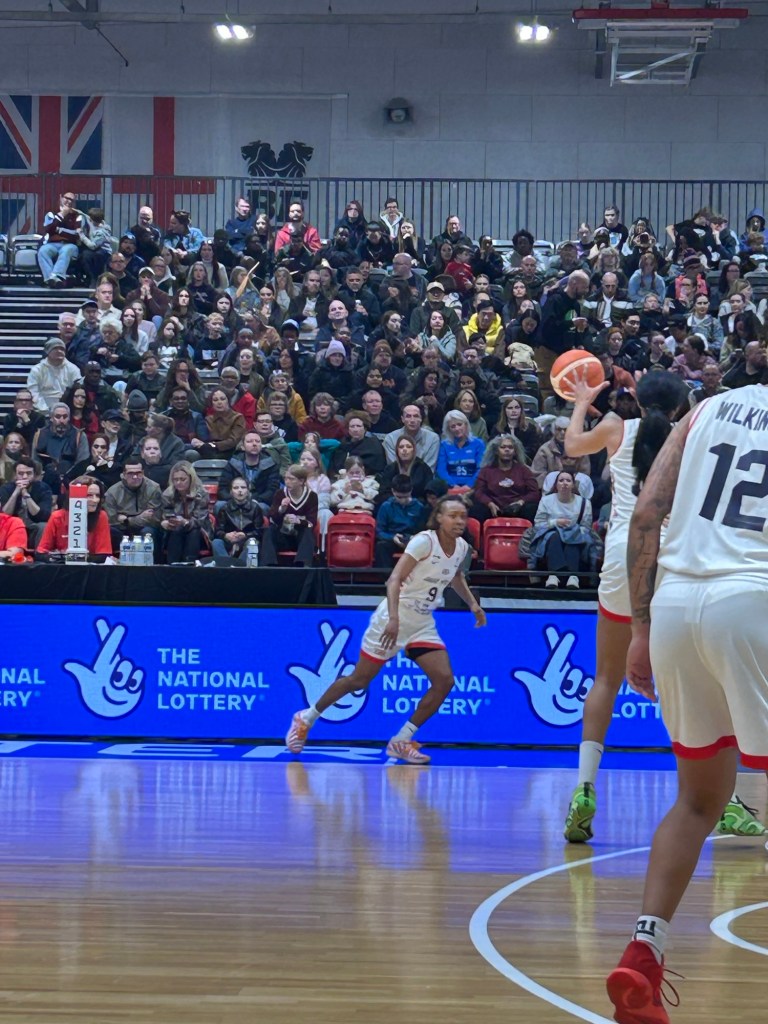
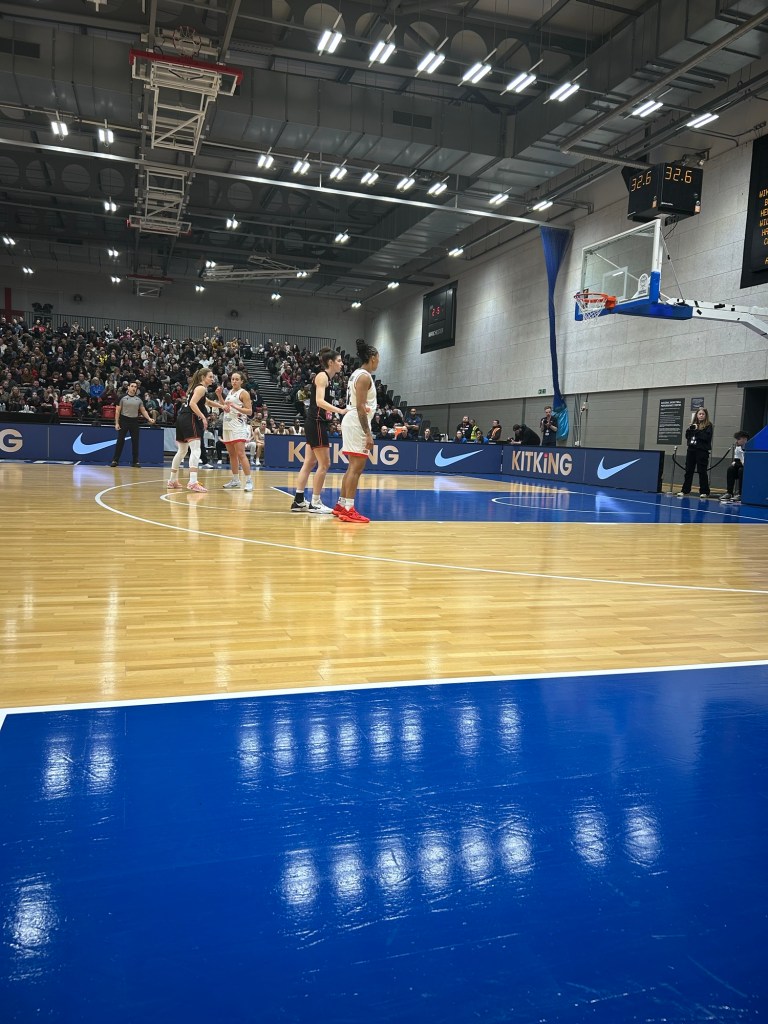
Last night I was courtside to see the Great Britain women’s basketball team victorious over Austria in a Women’s EuroBasket 2027 qualifying match.
The GB players were full of talent and enthusiasm and the atmosphere in the arena was fantastic. Hundreds of fans, including large numbers of young girls, many of whom were clearly basketball players, were cheering on the team, helped along by an energetic MC and DJ who created exactly the sort of environment basketball does so well.
The performance itself was hugely impressive. Austria arrived having topped the group so far, yet GB played with confidence, skill and determination to secure an important victory and progress to the next stage of the competition.
Several players stood out. Holly Winterburn led the scoring with 25 points. Kristine Anigwe added a commanding presence with 15. Savannah Wilkinson contributed 11 and Cheridene Green 10.
A personal note of bias is unavoidable. Shanice Beckford-Norton is a friend and her style of play was calm, technically excellent, and endlessly energetic: she seemed to be everywhere on the court, supporting both attack and defence and frequently feeding the ball to teammates in better scoring positions.
Watching the game it was difficult not to think that we were seeing something important. The diversity of the squad, the clear passion of the players and the quality of their basketball all pointed to a simple conclusion.
The future of British basketball may well lie with the women’s game.
A surprising convert
My own enthusiasm for basketball arrived rather later in life than most.
At school, I was put off the sport by a PE teacher who used endless basketball lay-ups as a convenient way to fill lesson time without ever attempting to inspire any real interest in the game. That was not particularly helpful for someone already struggling with dyspraxia and could barely dribble let alone throw or catch a ball with any degree of accuracy.
Yet over time I became a convert. In 2017 I wrote on this site about the importance of supporting basketball in Britain. Since then I became much more deeply involved in the sport.
For six years I served on the board of the British Basketball League and saw both the promise and the dysfunction of the professional game at close quarters.
My appointment came thanks to the encouragement of my good friend Lisa Wainwright, then Chief Executive of GB Basketball. I was interviewed by Kevin Routledge of Leicester Riders and Andy Webb, the league’s outstanding Chief Operating Officer. Above all, I had the privilege of serving under the chairmanship of Sir Rodney Walker, one of the most experienced figures in British sport governance and someone from whom I learned a great deal.
At the time our ambition was straightforward. We wanted the league to become better.
The BBL ran its competitions well and its three major events, the Cup, Trophy and Play-Off Finals, were excellent showcases. But financially the league remained fragile. Attendances were modest, revenues limited and growth required investment.
There was also an obvious structural weakness. The men’s and women’s professional leagues were run by separate organisations. The women’s league operated on minimal resources and relied heavily on the administrative support of the BBL’s small staff team.
That fragmentation never made sense.
Structural weaknesses
From the outset it was clear the professional game faced serious challenges.
Every club was undercapitalised. Ownership structures were fragmented and disagreements between club owners were common. Governance had improved after Sir Rodney’s appointment and the introduction of independent non-executive directors, but personalities still played a disproportionate role in decision making.
External investment appeared to offer the breakthrough the sport needed. The league simply could not generate the capital required for growth from its own resources.
The ambitions were sensible. Increase audiences both in arenas and online. Build stronger commercial partnerships. Expand the league into new cities.
In theory it was exactly what British basketball required.
In practice things proved far more complicated. Some club owners were reluctant to surrender control even though meaningful investment inevitably requires it. Meanwhile the investors moved quickly and sometimes struggled to bring the clubs with them.
Financial, governance and cultural tensions combined. Personalities clashed and alignment proved elusive. It wasn’t helped by the investors themselves being overstretched and under scrutiny due to their efforts to acquire a prominent premiership football club, which ultimately was their undoing and that of the BBL.
The British Basketball Federation also came a cropper under its chair Chris Grant. Grant had sided with some BBL club owners to oust the US investors, but then turned on them and chose a different vehicle as the licensed pro league to the one they set up. Feathers flew and eventually global governing body FIBA intervened and withdrew the BBF’s status as the GB national federation, ultimately causing the BBF to fail itself.
British basketball had fallen into a familiar trap. Enormous enthusiasm for the sport from those involved, but fragile structures and bitter fights at the top of the game.
A fragmented system
Part of the problem lies in basketball’s governance structure in Britain.
The relationship between the professional league, the British Basketball Federation, the league, and the home nation governing bodies has long been uneasy. On paper the responsibilities are clear. In practice tensions are constant.
The professional league historically had more money than the federation, which relied heavily on limited public funding. Meanwhile wheelchair basketball and grassroots participation and development pathways were managed by separate organisations in England, Scotland, and Wales, each with their own priorities.
The result has been a fragmented system lacking clear strategic leadership and an irritating divergence of constituencies each seeking their own commercial partners and media deals.
In my view the sport would be far better served by a single governing body for basketball across Great Britain covering elite performance, professional leagues, participation, talent pathways and wheelchair basketball for both men and women. The existing home nation associations could become national committees within that structure, responsible for matters which are home nation specific, like Commonwealth Games .
It would be simpler, clearer and far more strategic.
The paradox of British basketball
What makes the situation particularly frustrating is that basketball remains hugely popular at grassroots level.
It is one of the most widely played sports in Britain, especially in urban communities and among young people from diverse backgrounds. Few sports reflect the diversity of modern Britain as clearly as basketball.
Yet the sport receives remarkably little attention from the British media.
A couple of times this week I opened the BBC Sport app looking for coverage of the GB women’s qualifying games against Switzerland and Austria. I found nothing. Not even the scores.
Both were significant international fixtures. Both were victories that secured progression in a major European competition. Yet the BBC carried no coverage at all. Instead the basketball pages were filled with reports of (men’s) NBA games from the United States.
If British audiences are never shown British basketball, it is hardly surprising that the sport struggles to attract wider support.
Why the women’s game matters
Against that backdrop the rise of the GB women’s team is particularly encouraging.
Like several other sports, Britain’s women are currently outperforming the men internationally. The culture within the women’s game also appears notably more collaborative and community focused.
Many players are actively involved in grassroots initiatives and youth engagement. If their success continues, particularly in European competition and Olympic qualification, it should provide a powerful case for greater investment and visibility.
The women’s game may well become the catalyst for a broader revival of basketball in Britain.
Time for reform
For that revival to happen the sport must finally confront its structural weaknesses.
British basketball needs a properly funded, well capitalised and professionally governed national structure. The fragmentation between leagues, federations and national associations has held the sport back for far too long.
A unified governing body overseeing elite performance, professional leagues, grassroots participation and talent development would give the sport the clarity and credibility it needs.
It would also provide a far stronger platform for investors, sponsors and broadcasters.
A cautiously hopeful future
Despite everything that has gone wrong in recent years, I remain optimistic about the future of basketball in Britain.
Last night’s match was a reminder of what the sport can offer. Skill, excitement, diversity and genuine community spirit.
Watching those young girls cheering on the GB team, it was impossible not to feel hopeful.
British basketball has spent too long arguing about governance while the game itself quietly flourishes in sports halls and playgrounds across the country.
If the sport can finally put its institutional house in order and, with Government and funding council support, invest properly in its structures and build on the growing success of the women’s game, the best days of British basketball may still lie ahead.


 C. E. Lord OBE