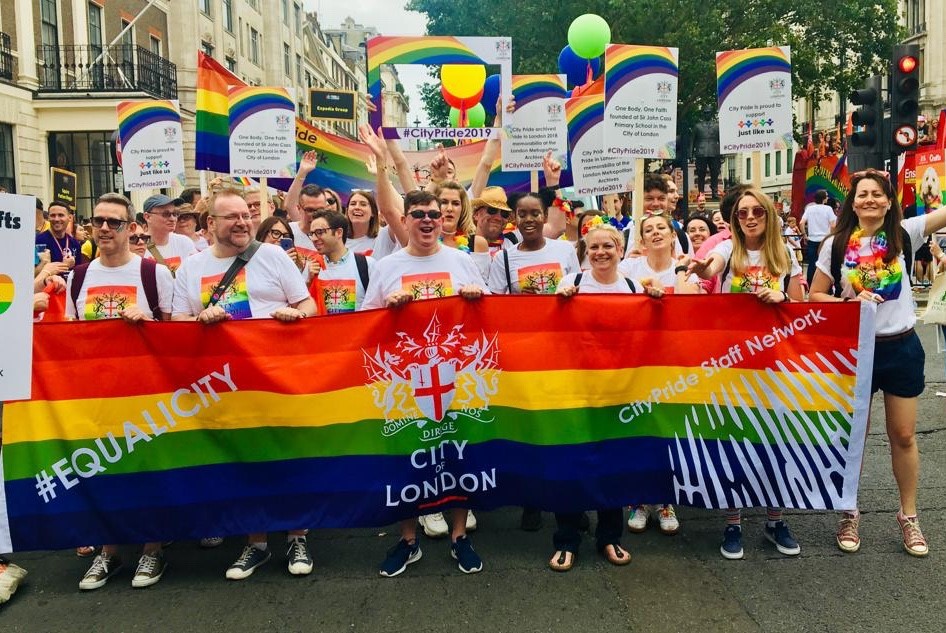
Every year, around this time, somebody asks whether Pride is still necessary.
It is a question that usually comes from one of two places. Sometimes it is asked in good faith by people who look around them and see same-sex marriage, openly LGBTQ+ public figures, rainbow lanyards in workplaces, and Pride flags flying above civic buildings, and conclude that the battle has largely been won. At other times, it is asked by those who never much liked Pride in the first place and who hope that, now we have secured some legal rights, we might quietly disappear back into the shadows.
My answer remains the same as it has been throughout my adult life.
Pride remains necessary because LGBTQ+ equality remains unfinished. Pride remains necessary because visibility matters. Pride remains necessary because prejudice has not disappeared. Pride remains necessary because every generation has to decide whether it will defend the freedoms won by those who came before or allow them to be eroded. And Pride remains necessary because, for many LGBTQ+ people, particularly trans people, the political weather has become markedly colder.
And today, when the UK’s place in the global rankings for LGBTQ+ equality has plummeted in recent years, now more than ever, Pride must be both a celebration of LGBTQ+ people’s lives and a protest at the significant political undermining of our rights.
A celebration of survival, joy, and belonging
Given the deterioration of queer and trans rights in this country and overseas, there is a legitimate question about how Pride can still be regarded these days as a celebration.
To my mind there is still however much to celebrate: of lives once hidden and now visible; of relationships once criminalised and now recognised; and of communities that survived hostility, rejection, violence, silence, and exclusion.
For many LGBTQ+ people, Pride remains the one day each year when they can look around and see themselves reflected in thousands of others. For young people discovering who they are. For older people who remember a much darker era. For parents, families, allies, and friends. For those who have recently come out. For those who still cannot safely do so.
That sense of belonging matters. It mattered when I first attended Pride 33 years ago. It matters now.
The extraordinary progress made over recent decades did not happen by accident. It happened because generations of LGBTQ+ people chose visibility over fear and solidarity over silence. The freedoms many of us enjoy today were won through courage, persistence, and sacrifice.
Those achievements deserve to be celebrated. But celebration alone is not enough.
Pride was never meant to be comfortable
There is a temptation, particularly among institutions and corporations, to present Pride as a colourful summer festival detached from politics. That misunderstands both its origins and its purpose: Pride emerged from resistance.
It emerged because LGBTQ+ people were excluded from public life, criminalised by the law, condemned by churches and other religious groups, discriminated against by employers, and frequently abandoned by politicians.
The first Pride marches were not marketing opportunities. They were acts of courage. They were demands for justice. They were declarations that LGBTQ+ people would no longer accept invisibility.
The political edge of Pride is not an unfortunate inconvenience. It is part of its DNA. That is why attempts to reduce Pride to rainbow branding, while remaining silent about attacks on LGBTQ+ rights, ring hollow.
A rainbow logo is easy. Standing alongside marginalised communities when doing so attracts criticism is much harder. Pride asks institutions not merely to celebrate diversity, but to demonstrate moral courage. This is especially important at a time when Trump’s administration in the US actively attacks businesses, universities, and public services who stand up for their LGBTQ+ stakeholders and when in the UK the anti-trans hate group Sex Matters threatens legal action against anyone who refuses to comply with their warped interpretation of equality law.
The new front line
And thinking of those pernicious attacks, it is disturbing that today the most intense political battles are increasingly focused on trans people.
Over the past few years we have witnessed a growing campaign seeking to portray trans people as a threat rather than as fellow citizens deserving dignity and respect. The language has become harsher. The rhetoric more polarised. The public debate less humane.
Social media platforms amplify outrage. Just as the fascists did almost a century ago, some politicians have discovered that attacking small and vulnerable minorities can generate headlines. Some sections of the media have become fixated on trans existence in a way that would seem extraordinary if applied to almost any other group.
The result is that many trans people feel less secure today than they did a decade ago. That should concern all of us.
Whether one is discussing access to services, participation in sport, healthcare, education, or legal recognition, there will inevitably be difficult policy questions. Mature democracies are capable of debating those questions.
What we must never do is lose sight of the humanity of the people affected. Trans people are not abstractions. Trans people are our colleagues, friends, classmates, family members, neighbours, fellow worshippers, and fellow citizens. Trans people deserve the same dignity, respect, and protection from discrimination as everyone else.
I have consistently argued that women’s rights and trans dignity are not mutually exclusive. The attempt to force society into choosing one or the other represents a false choice that generates far more heat than light.
Good policy starts with recognising the humanity of everyone involved. It starts with listening rather than caricaturing. And it starts by refusing to treat vulnerable minorities as political footballs.
The international backlash against equality
It would be comforting to believe that what we are witnessing is simply a series of isolated domestic disputes about policy. Unfortunately, the evidence increasingly points in another direction. Across much of the world, we are seeing a coordinated political backlash against LGBTQ+ rights, diversity initiatives, and the broader principles of equality and inclusion.
In Russia, LGBTQ+ activism has effectively been criminalised. In Hungary under the previous premier Viktor Orban, LGBTQ+ visibility was systematically restricted by the state. Across parts of the United States in support of the Trumpian anti DEI agenda, legislators have introduced wave after wave of measures targeting trans people, restricting healthcare, limiting participation in public life, and attempting to erase LGBTQ+ identities from schools and public institutions.
At the same time, we have witnessed growing attacks on diversity, equality, and inclusion programmes more generally. Measures designed to tackle discrimination and widen opportunity are increasingly portrayed by some politicians as a threat rather than a strength.
This is not a coincidence.
When political movements struggle to offer convincing solutions to complex economic and social challenges, there is often a temptation to identify convenient minorities as the source of society’s problems. The targets may change from era to era, but the political technique remains remarkably familiar.
A small, often misunderstood group is presented as powerful and threatening. Their visibility is characterised as undue influence. Measures designed to protect them from discrimination are portrayed as unfair privileges. The majority is told that its interests are somehow being undermined by the rights of a minority. We should recognise this pattern because history has shown us where it leads.
The overwhelming majority of trans people are simply trying to live their lives. They want the same things everyone else wants: safety, dignity, friendship, family, meaningful work, and the freedom to participate fully in society. Yet they have increasingly become the focus of a political debate wildly disproportionate to their numbers or influence.
That should give us pause. Because when any minority becomes a convenient political target, the question is not simply what happens to that minority. The question is what kind of society we are becoming.
The defence of LGBTQ+ equality is therefore not merely about LGBTQ+ people.
It is about whether we continue to believe that diversity is a strength rather than a threat; whether democratic societies protect minorities or scapegoat them; and whether human dignity applies universally or only when it is politically convenient. These are questions that go far beyond Pride. They go to the heart of the kind of country, and indeed the kind of world, we wish to build.
History teaches us that attacks on minority groups rarely stop with one minority group. When societies become comfortable with singling out one community for exclusion, suspicion, or reduced rights, the consequences rarely remain confined to that community alone.
The principles at stake are universal.
- Human dignity.
- Equal treatment.
- Freedom of expression.
- Freedom of association.
- The right to live openly and authentically.
- The right to participate fully in society.
These are not merely LGBTQ+ issues. They are democratic values. Defending those values benefits everyone.
Pride, Faith, Hope, and Love
As a Christian, I am also conscious that many LGBTQ+ people continue to experience rejection in religious settings. Some churches and other religious institutions have become places of welcome and affirmation. Others remain places of pain.
I continue to believe that faith communities are at their best when they reflect the radical inclusiveness demonstrated by Christ himself.
Every human being bears the image of God. Every human being possesses inherent dignity. Every human being deserves to know that they are loved.
That conviction informs my politics, my public service, and my understanding of Pride.
Pride is not a rejection of faith. For many of us, it is an expression of the belief that every person has worth and that injustice should never be accepted as inevitable.
The task ahead – why Pride still matters
As I have previously intimated, the greatest mistake we could make would be to assume that progress towards LGBTQ+ equality is irreversible. It is not.
Rights can be weakened. Protections can be dismantled. Hostility can be normalised.
History provides more than enough examples. That is why Pride still matters.
It matters because it reminds LGBTQ+ people that they are not alone. It matters because it tells young people that there is a future for them. It matters because it demonstrates solidarity across communities. It matters because it challenges injustice. And it matters because joy itself can be an act of resistance.
This year, as Pride flags are raised and Pride marches fill our streets, I will celebrate by marching in London, Belfast, Brighton and Derry.
I will celebrate the extraordinary diversity of our communities. I will celebrate the progress achieved through decades of activism. I will celebrate those who came before us and made our lives possible.
But I will also protest.
I will protest against discrimination, exclusion, and intolerance. I will protest against attempts to divide minorities from one another. I will protest against efforts to make trans people the latest target in a culture war they did not create. And I will protest against a growing international movement that seeks to roll back equality, weaken inclusion, and persuade us that diversity is somehow a problem to be solved rather than a reality to be embraced.
Because Pride was never simply about securing a place at somebody else’s table. It was about building a society in which every person can live openly, honestly, and without fear.
That work is not finished. Perhaps it never will be. Each generation is called upon to decide whether it will widen the circle of human dignity or narrow it. Whether it will stand with those facing hostility or look away. Whether it will defend equality when it is easy, and when it is difficult.
That is the choice before us today. And that is why Pride still matters.


