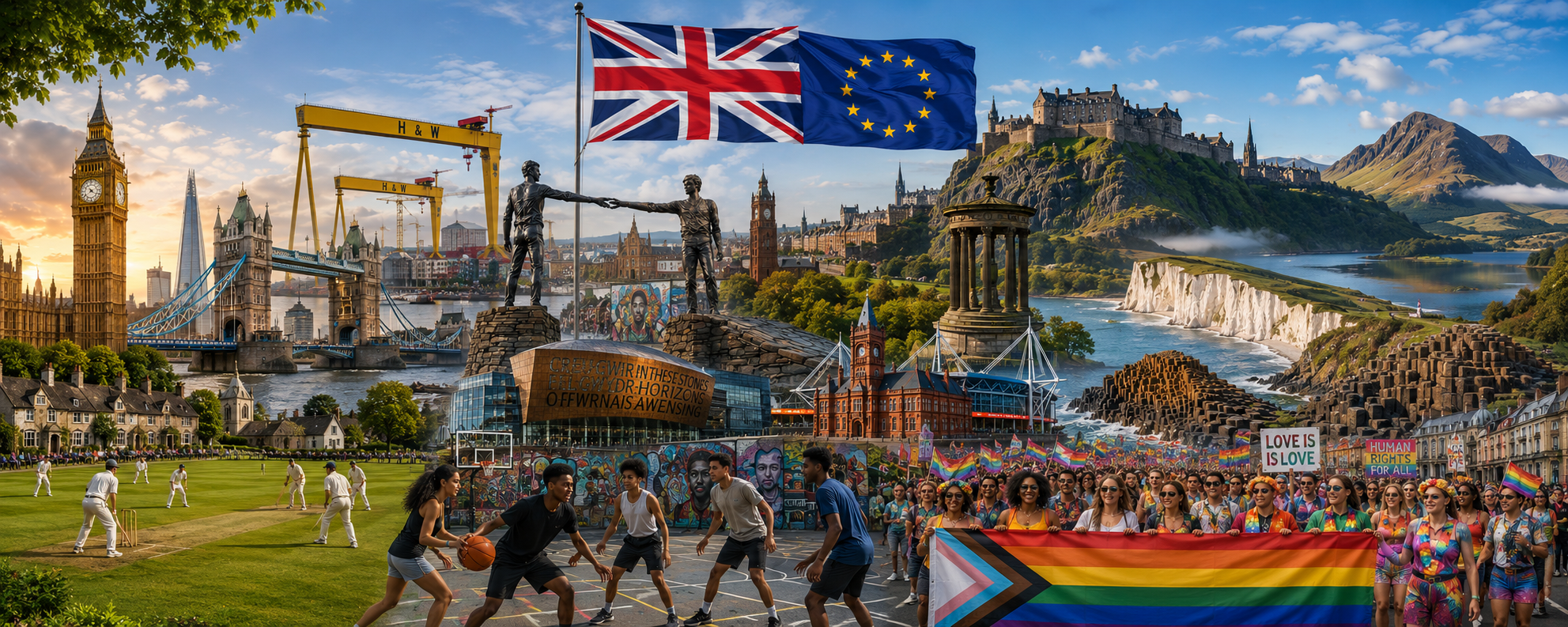
Ten years after the referendum, Britain is poorer, less influential, and less connected than it might have been. The time has come to make the case for re-joining the European Union.
A night I will never forget
Ten years ago this morning Britain awoke to a changed political landscape and a weakened place in the world.
The referendum result announced on 24 June 2016 was narrow. Just 51.9 per cent voted to leave the European Union and 48.1 per cent voted to remain. Yet from that slender majority flowed one of the most profound constitutional, economic, and social changes in modern British history.
I remember that night vividly.
I was at the Greater London counting control centre in Guildhall as results arrived from across the capital. As the night wore on, the mood changed. What had begun with cautious optimism gave way to growing concern. Then concern became disbelief. By dawn it was clear that Britain had chosen a path that would alter the country’s future for decades to come.
I had voted to remain.
But that was not always inevitable. In my youth I was a Eurosceptic. I served on the Council of Business for Sterling and on the Board of the Campaign for a British Referendum during the battles over the Maastricht Treaty. Like many people of my generation, I had concerns about the direction of European integration and the democratic accountability of European institutions.
Over time, however, I came to understand something more important.
The European Union was never simply an economic arrangement. It was a framework through which nations that had spent centuries fighting each other chose instead to cooperate. It provided rights, opportunities, influence, and security that no European nation could exercise alone. It allowed us to be both proudly British and proudly European.
And ten years ago we chose to walk away.
From Eurosceptic to European
My support for continued membership of the European Union was not born of ideology. It was born of experience.
Over the past three decades I have worked across higher education, local government, sport, business, and the voluntary sector. I have seen first-hand the benefits that flow from collaboration across borders. I have seen British universities strengthened by European research partnerships, businesses prosper through access to continental markets, and communities enriched by the free exchange of people, ideas, and culture.
Most importantly, I came to appreciate that sovereignty in the twenty-first century is not diminished by cooperation. It is enhanced by it. In an increasingly uncertain world dominated by continental-scale powers such as the United States, China, and India, Britain’s influence is greater when exercised alongside our European neighbours than when exercised alone.
That truth seems even more obvious today than it did in 2016.
A failure of political leadership
The campaign that led Britain out of the European Union was one of the greatest failures of political leadership in modern times.
David Cameron called a referendum he neither needed nor truly believed in. Having spent years treating Europe as a problem to be managed rather than a partnership to be celebrated, he suddenly found himself trying to persuade the country that membership mattered. The argument lacked conviction because the Prime Minister himself had rarely displayed any.
Labour’s leadership was even less persuasive. Jeremy Corbyn’s party formally supported Remain, but few doubted his long-standing scepticism towards the European project. At precisely the moment when a united progressive coalition was required, the leadership of both major parties failed to make a compelling emotional and moral case for Britain’s place in Europe.
Leave offered a story about identity, sovereignty, and national renewal.
Remain offered a spreadsheet.
One spoke to the heart. The other spoke almost exclusively to the head. The tragedy is that much of what Remain predicted has subsequently come to pass.
The economic verdict is in
Ten years ago both sides made predictions. Today we no longer need predictions. We have evidence and that evidence is overwhelming.
Brexit has reduced trade with our largest and most important market. It has increased costs for businesses, discouraged investment, weakened productivity, and reduced economic growth. Independent economists differ on the precise scale of the damage, but they no longer disagree that damage has occurred. Britain is poorer than it would otherwise have been.
The impact has not always been dramatic or visible. There was no single moment when the economy collapsed. Instead, Brexit has acted as a permanent drag on prosperity, slowly but steadily reducing growth and opportunity.
Thousands of small exporters have abandoned European markets because the administrative burden no longer makes commercial sense. Investment has been weaker than it would otherwise have been. Productivity has suffered. Economic growth has been lower.
The advocates of Brexit promised that new global trade agreements would compensate for reduced integration with Europe. They have not. Geography still matters.
The European Union remains the world’s largest integrated market on our doorstep. No collection of agreements with countries thousands of miles away can replicate the advantages of frictionless trade with our nearest neighbours.
A strong City in a weaker Britain
As someone who has served the City of London Corporation for more than a quarter of a century, I care deeply about the future of the City of London as a global financial and professional services centre.
The good news is that Brexit did not destroy the City. Predictions of immediate collapse were always exaggerated.London remains one of the world’s leading financial centres, a global hub for banking, insurance, legal services, professional advice, fintech, and capital markets.
But it would be equally wrong to pretend that Brexit has strengthened the City’s position. Business has migrated to European centres. Market share has been lost. Investment decisions have increasingly been made within the European Union rather than in Britain. What has occurred is not catastrophe, but attrition.
The City remains strong because of centuries of accumulated expertise, deep capital markets, respected institutions, and a global outlook. Yet there is no serious argument that Brexit has enhanced London’s competitiveness. A confident Britain should aspire not merely to preserve London’s position, but to strengthen it through closer engagement with our largest neighbouring market.
A country made smaller
For millions of people Brexit represented a loss that cannot easily be measured in pounds and pence. It narrowed the horizons of a generation. Most significantly, it meant the loss of European citizenship.
For those of us who valued that identity, this was not some abstract constitutional change. It was the removal of rights we had exercised throughout our adult lives. The right to live, work, study, retire, and build a future anywhere across a continent. The right to be both British and European.
I still feel bereft at having had that citizenship taken away by such a narrow margin.
For younger generations the loss may be greater still. Many of those whose futures were most affected were too young to vote in 2016. Opportunities that previous generations took for granted have become harder to access. Freedom of movement has ended. Educational exchanges have diminished. The horizons available to young Britons have narrowed.
A country that once encouraged its citizens to look outward has become more inward-looking. That is not progress.
The promises that were not kept
Perhaps the greatest irony is that Brexit failed even on its own terms. The promises made during the referendum campaign were straightforward:
- Britain would become more prosperous.
- Immigration would be dramatically reduced.
- Public services would receive substantial additional funding.
- The country would regain control.
A decade later none of these promises has been realised in the form in which they were presented.
Migration did not disappear. Instead, its composition changed. Public services remain under immense pressure. Economic growth has been weaker than it would otherwise have been. And sovereignty has turned out to be considerably more complicated than a slogan painted on the side of a bus.
The practical realities of trade, security, diplomacy, and regulation have proved far more powerful than the rhetoric of absolute independence.
Northern Ireland and the reality principle
No part of the United Kingdom better illustrates the contradictions of Brexit than Northern Ireland.
For more than twenty-five years Northern Ireland has been an important part of my personal and professional life. Through my work with the City of London Corporation, the Honourable The Irish Society, and more recently Ulster University, I have developed a deep affection for the people and communities of Northern Ireland and a profound commitment to its peaceful future.
I love the place and have seen at first hand the remarkable progress that has been made since the Good Friday Agreement. But, that progress should never be taken for granted.
Brexit promised simple answers to complicated questions. Northern Ireland demonstrated that reality is rarely so accommodating.
The Windsor Framework exists because geography, economics, and the peace process could not simply be wished away. The need to avoid a hard border on the island of Ireland collided with the decision to leave the European Union’s economic structures.
Facts eventually reasserted themselves. The lesson is an important one.
The future prosperity and stability of these islands depends upon cooperation, partnership, and mutual respect. Brexit made those objectives harder to achieve, not easier.
The country has moved on
Perhaps the most telling verdict on Brexit now comes not from politicians or commentators, but from the British public itself. Increasing numbers of people believe Brexit was a mistake. Among younger voters the view is even more pronounced.
This should not surprise anyone. Democracies learn.
The purpose of democracy is not to make a single decision and then prohibit future generations from revisiting it. The purpose of democracy is to allow nations to reflect upon experience and change course when the evidence demands it.
The evidence now demands exactly that.
The case for re-joining
In my opinion, given the evidence of Brexit’s manifold failures, Britain should re-join the European Union.
Not because the European Union is perfect. Not because we can somehow return to 2016. And certainly not because of nostalgia.
The case for re-joining is a case about the future.
It is a case for stronger economic growth, greater influence, enhanced security, improved opportunities for young people, deeper scientific and cultural collaboration, and a stronger voice on the global stage.
The question was never whether the European Union was perfect. The question was whether Britain was stronger inside it than outside it. Ten years later, the answer is unmistakable. We were.
The political challenge now is one of leadership.
Across British politics there are growing numbers of senior figures who privately acknowledge that Brexit has failed and that Britain will ultimately need a much closer relationship with Europe than current political orthodoxy permits. The next generation of leaders must find the courage to say publicly what many already know privately.
If politicians such as Andy Burnham genuinely believe Britain’s future lies in rebuilding our European relationships, they should be prepared to join with Ed Davey and others and make that case openly and honestly. Leadership means persuading people of difficult truths, not merely following opinion polls once the argument has been won.
The country deserves that honesty.
The Journey Home
Re-joining the European Union would require realism as well as ambition. It would involve obligations as well as benefits. It would require political courage. Most of all, it would require confidence.
Confidence that Britain’s future lies at the heart of Europe, not on its margins.
Confidence that cooperation strengthens sovereignty rather than diminishing it.
Confidence that our prosperity, security, and influence are enhanced when we work alongside our neighbours.
On 23 June 2016 Britain voted to leave the European Union. Ten years later the evidence is in, the promises have been tested, and the verdict is clear. Brexit was a mistake.
The next great national project, whoever our next Prime Minister is, should be to re-join.


