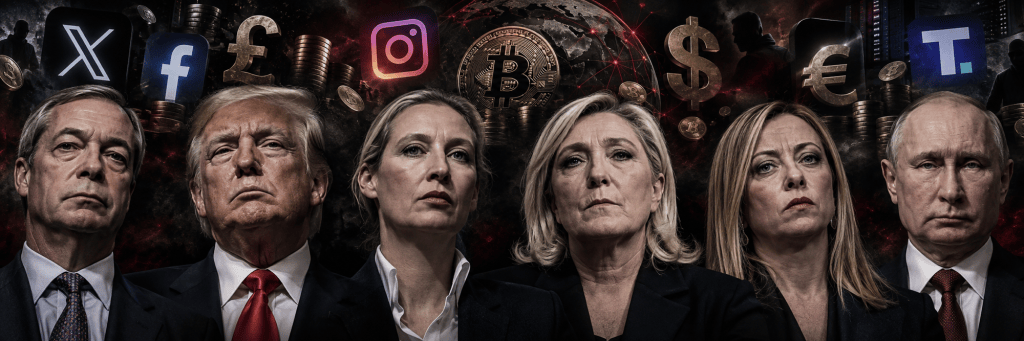
Reform UK’s record-breaking billionaire donation exposes a political funding system that allows private wealth to overwhelm democratic choice. Parliament must act before the next election.
A British political party has just secured the largest single donation in our political history.
Ben Delo, the cryptocurrency billionaire and co-founder of BitMEX, has announced a further £36 million for Reform UK, originally to be paid at the rate of £1 million a month until the next general election, but now to be given as a lump sum to overcome any potential new restrictions on political donations. That comes on top of £8 million he has already donated this year. One man is therefore committing £44 million to help propel Nigel Farage towards Downing Street.
This is not political participation on any ordinary understanding of the term. It is the attempted purchase of political power.
The sum involved is breathtaking. The new £36 million commitment alone is greater than the entire amount Labour spent contesting the last general election. It dwarfs the previous record contribution to a British political party. It gives Reform the capacity to employ an army of organisers, purchase enormous quantities of advertising, dominate social media, commission polling, target voters, and build a national campaigning machine years before the country next goes to the polls.
No individual should possess that much political power simply because they possess that much money.
Delo is entitled to his political opinions. He is entitled to vote, campaign, speak, organise, and donate a reasonable sum to a political party. What he should not be entitled to do is distort the democratic choices of tens of millions of citizens by deploying a fraction of his private fortune on a scale with which no ordinary voter could ever compete.
Democracy is founded on political equality. It rests on the principle that each citizen’s voice matters, irrespective of wealth, status, or social position. The moment we allow billionaires to amplify their voices tens of millions of times over, that principle becomes a fiction.
Reform was never on the side of ordinary people
Reform UK presents itself as an insurgency against an out-of-touch establishment. Farage poses as the tribune of people who feel ignored, patronised, or abandoned. He rails against elites while surrounded by millionaires, billionaires, hedge-fund financiers, cryptocurrency speculators, and wealthy expatriates.
The hypocrisy could hardly be more complete.
Reform UK can never credibly claim to be on the side of ordinary people while it is financially dependent upon crypto billionaires. But the truth is that it never was.
Its populist performance has always concealed an economic programme designed to serve the wealthy. Reform encourages people who are struggling to blame migrants, refugees, trans people, environmentalists, public servants, and some amorphous “woke elite” for problems created by decades of inequality, insecure employment, regional neglect, underinvestment, and the concentration of wealth.
Then, having manufactured the scapegoats, it proposes policies that would further weaken the public realm on which ordinary people depend.
Its economic prospectus includes vast reductions in public spending, attacks on welfare provision, deregulation, tax cuts, and an ideological assault upon the Civil Service and public institutions. Its latest plans contemplate tens of billions of pounds in cuts. The inevitable consequences would be felt not by billionaires, but by disabled people, low-paid families, pensioners, council tenants, NHS patients, and communities already hollowed out by austerity.
This is plutocracy dressed up as populism.
Reform does not challenge the concentration of economic power. It weaponises the anger that concentration creates, directing it away from those with the greatest wealth and towards minorities with the least power.
That is why I describe Reform UK as neo-fascist. I do not use the term casually. Its politics depends upon aggressive nationalism, the identification of internal enemies, hostility towards minorities, contempt for supposedly obstructive institutions, the cult of a dominant leader, and the claim that only it represents the “real people”. It wraps reactionary economic policies in flags and grievance, while portraying pluralism, equality, expertise, and independent institutions as forms of national betrayal.
The international playbook
We have seen this method before.
It is the playbook of Donald Trump and MAGA in the United States: billionaires funding a movement that tells working people their enemies are immigrants, trans people, racial justice campaigners, journalists, academics, and public servants. In the 2024 US election, technology magnates and cryptocurrency interests poured hundreds of millions of dollars into political campaigning. Elon Musk alone reportedly spent more than $240 million supporting Trump. Banking heir Timothy Mellon gave $115 million to a pro-Trump super PAC.
The rhetoric was anti-establishment. The financing came from the richest people on Earth.
Reform seeks to import that model into Britain. The language of “woke” enemies, national decline, mass deportation, deregulation, attacks on diversity initiatives, and hostility towards an allegedly treacherous state bureaucracy is not coincidentally similar. It is part of a common far-right political project.
The parallels extend across Europe.
Germany’s Alternative für Deutschland has combined extreme anti-migration rhetoric, hostility towards multiculturalism, attacks on LGBTQ+ equality, and opposition to support for Ukraine. Individual AfD politicians have faced investigation over alleged links with Russian influence operations, including claims involving the pro-Kremlin Voice of Europe network. Those accused have denied wrongdoing, and allegations must not be presented as convictions, but the pattern of scrutiny is profoundly troubling.
Marine Le Pen’s National Rally in France built its advance by normalising similar themes: hostility towards migration, ethno-nationalism, attacks on progressive values, and the portrayal of independent institutions as enemies of the popular will. The party previously obtained a €9.4 million loan from a Russian bank, subsequently repaid, after saying that French banks would not lend to it.
Giorgia Meloni’s Brothers of Italy emerged from Italy’s post-fascist political tradition and has used nationalism, hostility to migration, attacks on so-called “gender ideology”, and an intensely conservative conception of family and nation to achieve power. Meloni has proved more pragmatic in government on some international questions, particularly Ukraine, but her party remains part of the same broader project to shift the boundaries of acceptable politics sharply to the right.
These movements are not identical. Their histories, policies, and funding structures differ. But they share a political method: billionaire-friendly economics combined with cultural warfare; hostility towards minorities combined with the promise of national rebirth; and attacks upon democratic safeguards presented as liberation from an illegitimate elite.
Farage is Britain’s most practised exponent of that method.
Follow the money, and follow the bots
The £36 million announcement is even more disturbing because it comes amid serious questions about Reform UK’s finances.
The Metropolitan Police has launched an inquiry following allegations concerning possible overseas donations. The Electoral Commission has also considered material arising from an undercover investigation in which senior Reform figures were alleged to have discussed arrangements through which a foreign donor could fund political activity. Reform suspended two aides after the investigation and has said that it did not accept unlawful money.
Separately, the Parliamentary Commissioner for Standards resumed an inquiry relating to Farage and an alleged £5 million personal gift. Again, that is an investigation, not a finding of guilt, and Farage disputes wrongdoing.
These distinctions matter. But so does the cumulative picture. A party aspiring to govern Britain is simultaneously receiving unprecedented support from a handful of exceptionally wealthy individuals while facing questions about overseas money, donor compliance, and declarations concerning its leader.
There are also legitimate concerns about artificial amplification online.
Research by the Alan Turing Institute’s Centre for Emerging Technology and Security found accounts exhibiting bot-like behaviour promoting Reform during the 2024 general election campaign. Some associated activity also spread pro-Russian narratives, hate speech, and conspiracy theories. The researchers did not establish that Reform commissioned those accounts, nor did they conclusively attribute them to a Russian operation. They did, however, identify characteristics consistent with techniques previously used by Russian bot farms.
That distinction must be maintained, but the democratic threat should not be minimised. A hostile state does not need formally to finance a party to benefit from amplifying its messages. Russia’s objective is frequently not to secure one particular electoral result, but to weaken trust, inflame social divisions, spread cynicism, and make democratic government appear incapable of functioning.
A movement built around anger, conspiracy, cultural conflict, and distrust of institutions offers ideal material for such interference.
The former Reform politician Nathan Gill was sentenced to imprisonment after admitting accepting bribes to make pro-Russian statements while serving as a Member of the European Parliament. That does not establish misconduct by Reform itself, but it demonstrates that attempted foreign influence is not a paranoid fantasy. It is a real threat requiring robust safeguards.
Labour must find its courage
The Government’s proposed restrictions on overseas donations, stronger “know your donor” duties, tighter rules for company donations, and a moratorium on cryptocurrency donations are welcome. They address genuine vulnerabilities in our electoral system.
But they do not answer the question posed by this £36 million donation.
Ben Delo is British and is reported to have returned to live in the United Kingdom. The donation is reportedly being made in sterling, rather than cryptocurrency. Rules aimed only at foreign donors, shell companies, or anonymous crypto transactions may therefore do nothing to prevent one domestic billionaire from overwhelming the political process.
That is why Britain needs a comprehensive cap on political donations.
It must apply to individuals, companies, unincorporated associations, loans, benefits in kind, and networks of connected entities. It must prevent donors from evading the limit by dividing money among companies or intermediaries. It must be backed by proper investigative powers, meaningful penalties, and an Electoral Commission with the independence and resources required to enforce the law.
A cap should be accompanied by measures that strengthen democratic participation: matched funding for small donations, greater transparency, tighter campaign-spending rules, and carefully designed public support linked to genuine electoral backing.
There will need to be fair provisions for membership organisations, including trade unions, whose political funds represent the aggregated contributions of many thousands of working people rather than the purchasing power of a single oligarch. That is a distinction law can recognise.
Labour MPs who have pressed for a donation cap are right. Ministers who have retreated from it are wrong.
The Government must stop hesitating. It still has an opportunity to amend the Representation of the People Bill and prevent the next general election from becoming an auction.
Our country belongs to all of us
This is bigger than Reform UK. No party should be beholden to a billionaire. I would oppose a £36 million donation to Labour, the Conservatives, the Liberal Democrats, the Greens, or any other party with precisely the same determination.
The democratic principle is universal: political influence must not be allocated according to private wealth.
Yet the Reform donation brings the danger into exceptionally sharp focus. A party that demonises minorities, attacks public institutions, promises enormous spending cuts, and imitates the methods of MAGA is being equipped with an unprecedented war chest by a cryptocurrency billionaire pardoned by Donald Trump after a US conviction for failing to implement adequate anti-money-laundering controls.
Farage calls this a challenge to the establishment. It looks rather more like one wealthy man financing another wealthy man’s pursuit of power.
Britain is not a company to be acquired. Downing Street is not a commodity to be purchased. Votes are not crypto tokens, and citizenship is not a shareholding allocated in proportion to wealth.
Our democracy belongs equally to the nurse and the billionaire, the care worker and the hedge-fund manager, the pensioner and the property magnate. It belongs to every one of us.
The law must now defend that principle.
Cap political donations. Close the loopholes. Strengthen the Electoral Commission. Act before the next election.
Politics, in Britain and overseas, must not be for sale.
Shockingly, shortly after I published this piece Christopher Harborne matched the £36 million donation to Reform UK, giving the party a war chest of £72 million, far more than all of the other parties could hope to achieve.


 C. E. Lord OBE